
Instructions to use TIGER-Lab/SWE-Next-7B with libraries, inference providers, notebooks, and local apps. Follow these links to get started.
- Libraries
- Transformers
How to use TIGER-Lab/SWE-Next-7B with Transformers:
# Use a pipeline as a high-level helper from transformers import pipeline pipe = pipeline("text-generation", model="TIGER-Lab/SWE-Next-7B") messages = [ {"role": "user", "content": "Who are you?"}, ] pipe(messages)# Load model directly from transformers import AutoTokenizer, AutoModelForCausalLM tokenizer = AutoTokenizer.from_pretrained("TIGER-Lab/SWE-Next-7B") model = AutoModelForCausalLM.from_pretrained("TIGER-Lab/SWE-Next-7B") messages = [ {"role": "user", "content": "Who are you?"}, ] inputs = tokenizer.apply_chat_template( messages, add_generation_prompt=True, tokenize=True, return_dict=True, return_tensors="pt", ).to(model.device) outputs = model.generate(**inputs, max_new_tokens=40) print(tokenizer.decode(outputs[0][inputs["input_ids"].shape[-1]:])) - Notebooks
- Google Colab
- Kaggle
- Local Apps
- vLLM
How to use TIGER-Lab/SWE-Next-7B with vLLM:
Install from pip and serve model
# Install vLLM from pip: pip install vllm # Start the vLLM server: vllm serve "TIGER-Lab/SWE-Next-7B" # Call the server using curl (OpenAI-compatible API): curl -X POST "http://localhost:8000/v1/chat/completions" \ -H "Content-Type: application/json" \ --data '{ "model": "TIGER-Lab/SWE-Next-7B", "messages": [ { "role": "user", "content": "What is the capital of France?" } ] }'Use Docker
docker model run hf.co/TIGER-Lab/SWE-Next-7B
- SGLang
How to use TIGER-Lab/SWE-Next-7B with SGLang:
Install from pip and serve model
# Install SGLang from pip: pip install sglang # Start the SGLang server: python3 -m sglang.launch_server \ --model-path "TIGER-Lab/SWE-Next-7B" \ --host 0.0.0.0 \ --port 30000 # Call the server using curl (OpenAI-compatible API): curl -X POST "http://localhost:30000/v1/chat/completions" \ -H "Content-Type: application/json" \ --data '{ "model": "TIGER-Lab/SWE-Next-7B", "messages": [ { "role": "user", "content": "What is the capital of France?" } ] }'Use Docker images
docker run --gpus all \ --shm-size 32g \ -p 30000:30000 \ -v ~/.cache/huggingface:/root/.cache/huggingface \ --env "HF_TOKEN=<secret>" \ --ipc=host \ lmsysorg/sglang:latest \ python3 -m sglang.launch_server \ --model-path "TIGER-Lab/SWE-Next-7B" \ --host 0.0.0.0 \ --port 30000 # Call the server using curl (OpenAI-compatible API): curl -X POST "http://localhost:30000/v1/chat/completions" \ -H "Content-Type: application/json" \ --data '{ "model": "TIGER-Lab/SWE-Next-7B", "messages": [ { "role": "user", "content": "What is the capital of France?" } ] }' - Docker Model Runner
How to use TIGER-Lab/SWE-Next-7B with Docker Model Runner:
docker model run hf.co/TIGER-Lab/SWE-Next-7B
SWE-Next: Scalable Real-World Software Engineering Tasks for Agents
SWE-Next-7B
SWE-Next-7B is a repository-level software engineering agent fine-tuned from Qwen/Qwen2.5-Coder-7B-Instruct on the released SWE-Next SFT Trajectories. The model is trained with full-parameter supervised fine-tuning on execution-grounded trajectories collected from real merged pull requests and validated repository environments.
Introduction
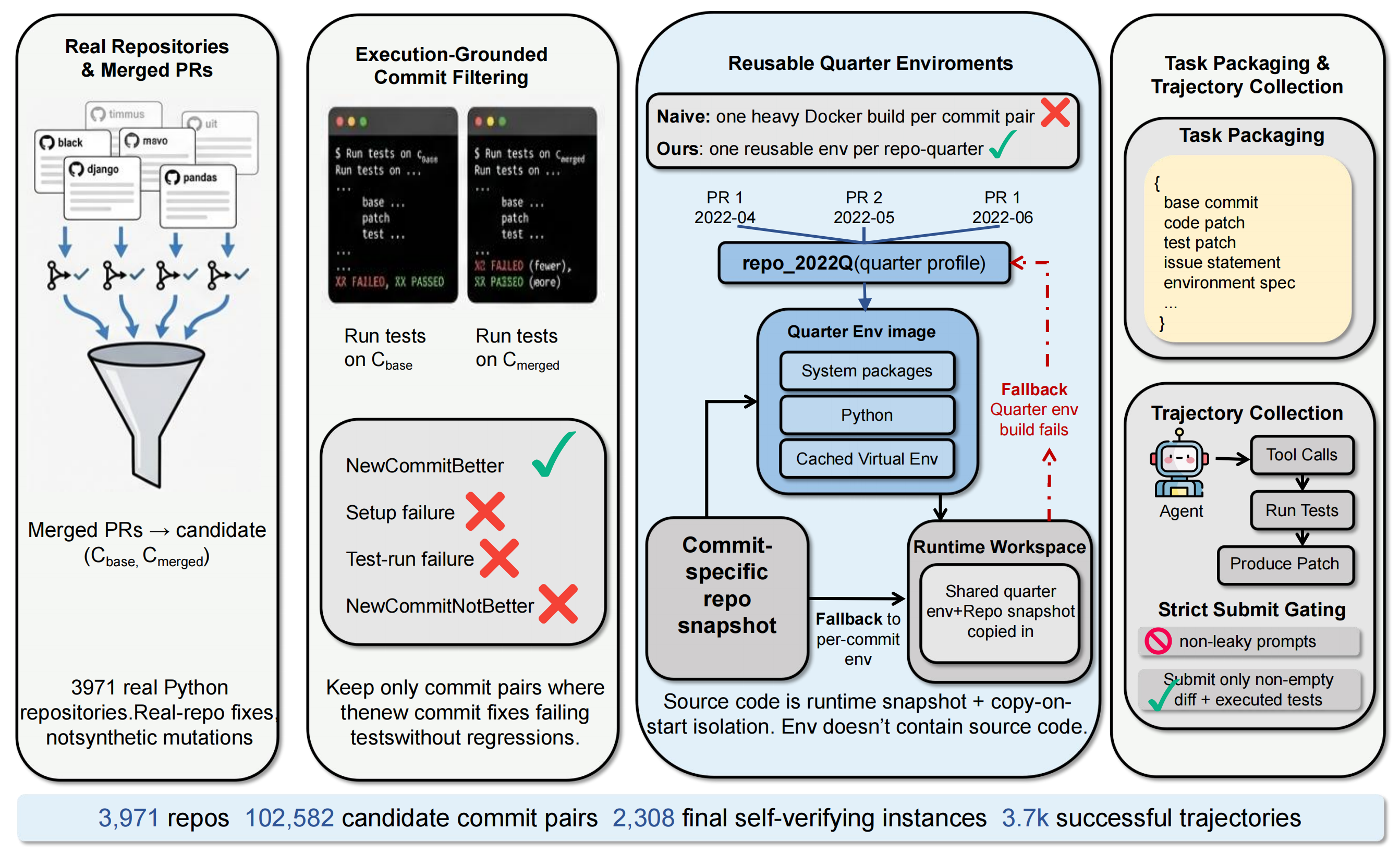
SWE-Next introduces reusable repo-quarter profiles, which reuse the same environment across nearby commits in time while keeping each task run separate and reproducible. Using only 30 hours and 639GB of environment storage, SWE-Next processes 3,971 seed repositories and 102,582 candidate commit pairs mined from real merged PRs to construct a dataset of 2,308 self-verifying instances. SWE-Next improves downstream pass@1 on SWE-Bench Verified and SWE-Bench Lite with fewer or comparable training trajectories, making large-scale executable data collection far more practical and accessible for research.
Model Overview
This model is trained on 3,693 selected SFT trajectories derived from the SWE-Next collection. The training data emphasizes clean repository-level repair traces and recovery-style debugging trajectories rather than isolated code-completion examples.
Training recipe summary:
- Base model:
Qwen/Qwen2.5-Coder-7B-Instruct - Finetuning: full-parameter SFT
- Context length: 32,768
- Learning rate: 1e-5
- Scheduler: cosine
- Dataset:
TIGER-Lab/SWE-Next-SFT-Trajectories
Usage
For full usage details, please refer to the official SWE-Next GitHub repository. The repository provides the complete setup and evaluation workflow for released models, including:
- environment and dependency installation,
- dataset and trajectory downloads,
- training configurations for the 7B and 14B models,
- vLLM serving commands and repository-level evaluation scripts.
In particular, the GitHub repo contains the exact commands used to serve SWE-Next-7B and evaluate it on SWE-Bench-style tasks under the SWE-Next execution interface.
Relationship to the SWE-Next Release
This repo contains the released 7B model checkpoint. Related artifacts are available separately:
- Base task dataset:
TIGER-Lab/SWE-Next - SFT trajectories:
TIGER-Lab/SWE-Next-SFT-Trajectories - Companion model:
TIGER-Lab/SWE-Next-14B - Project code:
github.com/TIGER-AI-Lab/SWE-Next
Citation
@misc{liang2026swenextscalablerealworldsoftware,
title={SWE-Next: Scalable Real-World Software Engineering Tasks for Agents},
author={Jiarong Liang and Zhiheng Lyu and Zijie Liu and Xiangchao Chen and Ping Nie and Kai Zou and Wenhu Chen},
year={2026},
eprint={2603.20691},
archivePrefix={arXiv},
primaryClass={cs.SE},
url={https://arxiv.org/abs/2603.20691},
}
- Downloads last month
- 114






